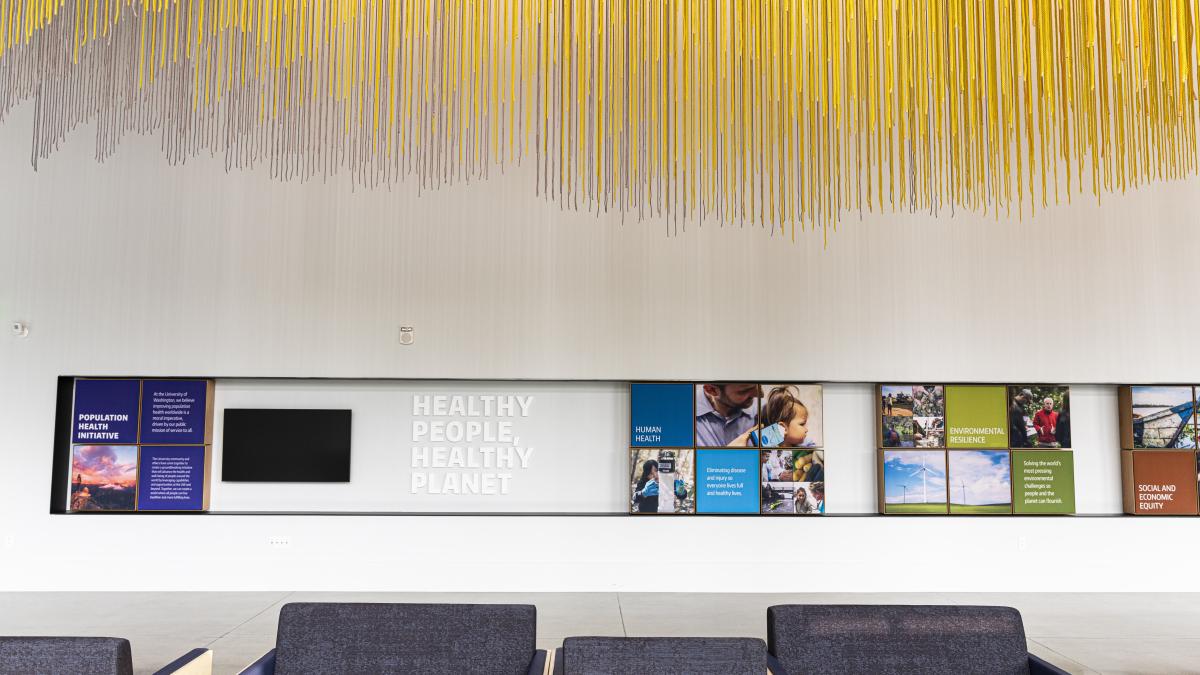
In CHanGE’s certificate program, UW graduate students work with stakeholders to address real-world climate and health needs through a hands-on capstone project. In certificate classes, students learn about climate science, methods for critically analyzing climate-health impacts, mitigation and adaptation strategies (ways to reduce and adjust to climate impacts), and how to effectively communicate complex information. The culminating capstone experience allows students to apply the interdisciplinary skills they learn in the classroom while receiving mentorship support from faculty.
This year, three students are graduating with CHanGE’s Certificate in Climate Change and Health. Each student is in a different graduate program, reflecting the certificate’s interdisciplinary nature and the importance of diverse minds tackling climate and health work. These students serve as a reminder that, regardless of discipline, sector, or background, we all have the power to drive change in building a more sustainable, climate-resilient future.
Recently, this year’s graduating students shared their capstone projects and findings at CHanGE’s end-of-year certificate event. Below are highlights of the innovative work done by these students who have transformed their studies into concrete impact.
Decreasing emissions at Harborview one bite at a time
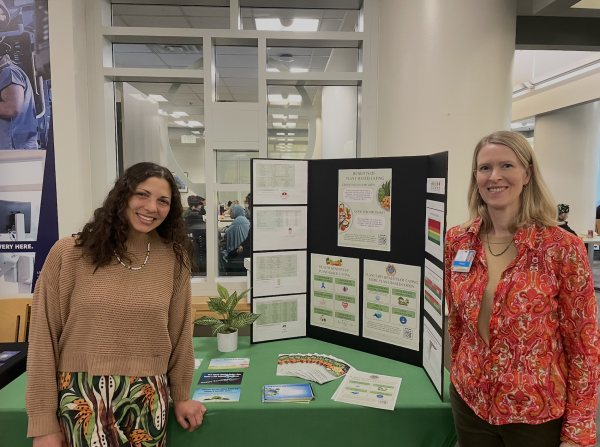
As a registered dietitian who graduated this spring with a master of public health in food systems, nutrition and health, Fernanda Nunes is passionate about how food systems affect human health and climate change. Her capstone project, completed in partnership with Harborview Medical Center, tackled this intersection by helping reduce greenhouse gas (GHG) emissions associated with food served in the hospital’s cafeteria.
As part of a sustainability plan, Harborview Medical Center committed to the World Resources Institute’s Coolfood Pledge. This pledge addresses the significant climate impact of food systems, which is estimated to account for a quarter of global GHG emissions, with the majority coming from animal-based products. Institutions that join this pledge commit to targeting a 25% reduction in food-related GHG emissions by 2030.
To support the Harborview team, Nunes calculated the GHG emissions associated with meals currently served in the cafeteria. This baseline estimate of current emissions will be essential for assessing progress towards the 25% reduction goal.
On Earth Day this year, Harborview launched a new plant-forward menu – which means that while animal-based options are still available, there are expanded and improved plant-based options. Nunes created educational materials, including brochures and flyers, about the purpose of the menu changes and what exactly is different to help facilitate this launch and keep customers informed. These materials also explain the benefits of a plant-forward diet for both human health and the planet.
When reflecting on her certificate experience, Nunes highlights the impact of the curriculum and the people. “The classes went above and beyond in not only teaching me about climate change but also connecting it to health,” Nunes shares. “The program opened my eyes to how much exists in this field and connected me to people interested and passionate about climate and health, which made me feel less alone in pursuing this intersection.”
Next year, Nunes will begin pursuing a doctorate at UW and will dive deeper into the intersection of climate change, health, and food systems.
Leveraging existing governance assets for climate-health action
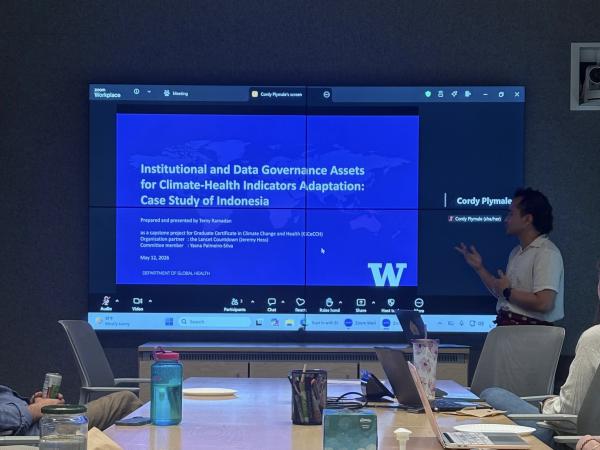
As climate change increasingly affects human health, governments need reliable ways to measure impacts on their populations and the effectiveness of interventions. Climate-health indicators are a key tool for this – metrics that can track these relationships and help decision-makers strengthen adaptation efforts.
For his capstone project, Temy Ramadan, who received a master of public health in global health, explored how countries can leverage existing governance strengths to adopt and sustain climate-health indicators. Using Indonesia as a case study, he examined two key areas: institutional governance (e.g., laws, policies, national commitments, and coordination mechanisms) and data governance (e.g., guidance on data collection, management, and use). He worked in partnership with the Lancet Countdown, an international research collaboration that monitors progress on climate change and health.
Using a conceptual framework informed by governance literature and an asset-based approach, Ramadan explored the quality of each asset, noting both strengths and areas for improvement. His work resulted in practical recommendations that can be used by governments to integrate climate-health indicators into decision-making processes using existing assets.
Rather than evaluating a country’s climate-health progress through a simple yes/no checklist, he argued that countries like Indonesia often exist on a spectrum – with policies, data systems, and coordination mechanisms at varying stages of development. By mapping what already exists and how ready it is to be mobilized, stakeholders can move beyond asking what’s missing and start asking what can be built upon to accelerate climate-health indicator adoption.
Prior to joining the certificate program, Ramadan had not worked directly in climate and health, yet he notes, “The CHanGE certificate program is a very welcoming environment. Everyone is very supportive, and I was able to connect easily with faculty and other passionate students. It gave me an opportunity to explore and learn more about the intersection of climate change and health and connect my passion for global health governance.”
Looking ahead, Ramadan plans to pursue a doctorate to deepen his work at the intersection of global health and climate change governance.
Using public health principles to build coastal resilience
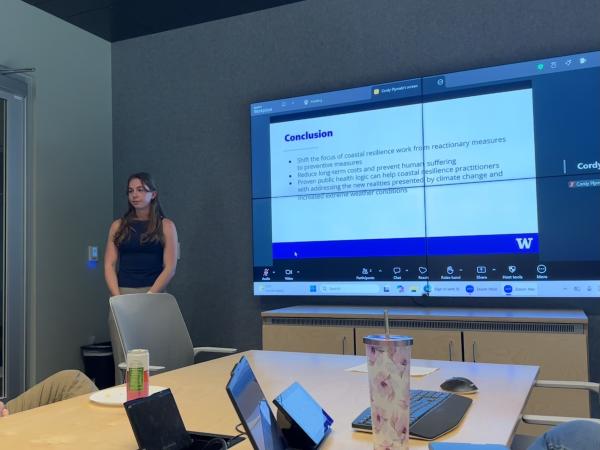
Through the certificate program, Maya Ades, who completed a master of marine and environmental affairs, drew connections between climate, health, and her passion for coastal work. She partnered with the Washington Coastal Hazards Organizational Resilience Team (COHORT) for her capstone project – a collaborative network of agencies working with coastal communities and Tribes to build resilience strategies in the face of climate hazards such as flooding, erosion, and sea-level rise.
To support COHORT’s goal of providing targeted support to vulnerable communities, Ades explored how public health principles can be applied to strengthen coastal resilience efforts in Brinnon, Washington. An unincorporated community on the eastern side of the Olympic Peninsula, Brinnon is particularly vulnerable to climate-related hazards. Not only is this due to its coastal location, but also socioeconomic vulnerabilities within the population that make it challenging to prepare for and respond to extreme weather events.
Using Brinnon as a case study and drawing on established public health frameworks, Ades developed internal guidance for COHORT that bridges the gap between public health concepts and the field of coastal resilience. For example, she used the Health Impact Pyramid to assess the effectiveness and feasibility of coastal interventions. And, she applied a preventive lens to illustrate how taking action to prevent harm from coastal hazards before they occur can help avoid both human suffering and long-term financial costs. As climate change presents new realities and exacerbates extreme weather conditions, her work provides timely guidance for COHORT about how coastal resilience practitioners can use public health logic to protect vulnerable communities.
For Ades, the CHanGE certificate was a unique opportunity to learn more about public health and bridge disciplines by integrating public health concepts into her coastal work. “This certificate pushed me to find an opportunity to work at the intersection of climate and health,” Ades says. “The open-ended structure of the certificate allowed me to apply my new knowledge to an area I was interested in.”
To learn more about CHanGE’s Graduate Certificate in Climate Change and Health and explore other impactful capstone projects completed by past students, visit here.