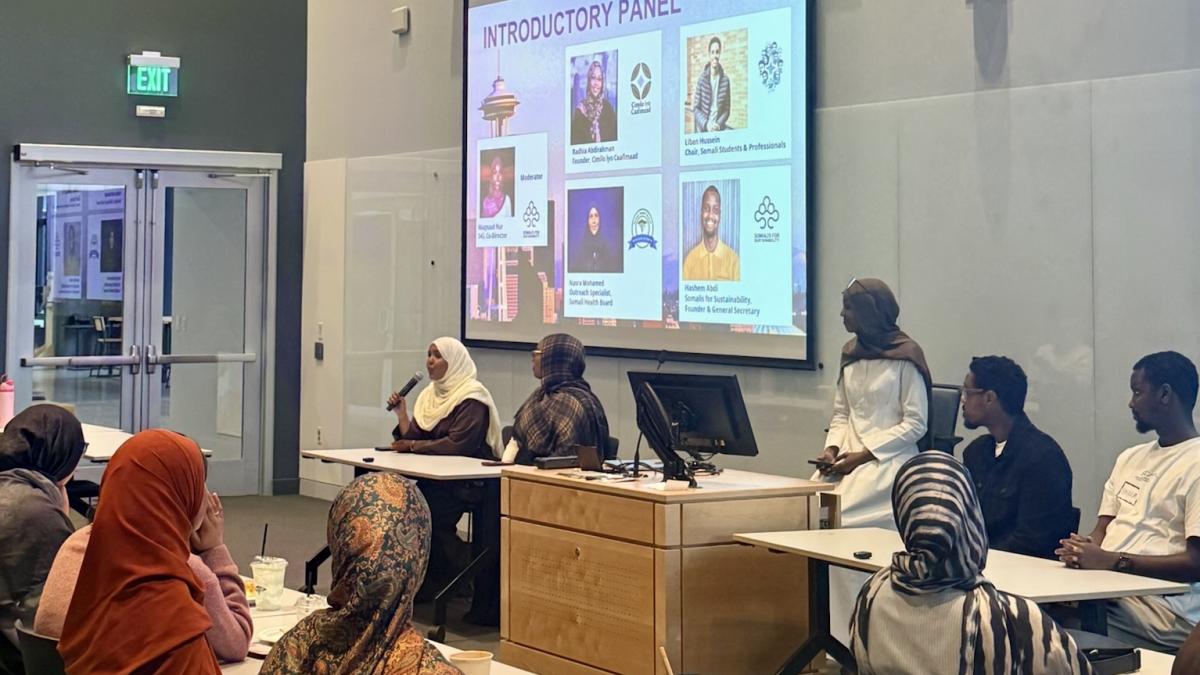
Founded in 2023, Somalis for Sustainability (S4S) has been working to empower Somalis worldwide to understand, address, and respond to climate, environmental, and health challenges affecting the Somali Horn. Here in Seattle, that mission has taken shape through a growing partnership with the University of Washington CHanGE and the Department of Global Health, developing with the organization's first U.S. event this past August.
According to the World Health Organization and firsthand accounts from S4S board members, the Greater Horn of Africa has been facing an escalating climate crisis. Recurring droughts and erratic rainfall have disrupted agriculture, caused food insecurity, altered disease patterns, and led to water shortages throughout the region, upending critical infrastructure.
Rooted in the belief that sustainability is integral to Somali identity, S4S works through advocacy events, research, storytelling, and climate education to create spaces where Somali voices are heard and centered in the climate conversation.
That mission took shape progressively, beginning with a conversation in London.
From London to Seattle
S4S was created after the founders attended a climate storytelling event in London, where they discussed their desire to see the Somali community represented in the climate and sustainability space. Developing S4S involved bringing together people working in the climate sector, and it officially launched in November 2023 at the landmark UN Climate Change Conference in Dubai.
“We felt that there wasn't enough representation in sustainability and climate careers, so we felt it would be great to maybe start an organization,” says S4S co-founder and director of networks and hubs, Ridwaan Yousuf.
Yousuf has a background in chemical engineering, but his focus quickly shifted to sustainability and climate. He started his career as a sustainability analyst at Amazon and, shortly after, began working for the sustainability consultancy ERM on international projects. He currently works for an NGO focused on sustainable agriculture.
S4S examines issues in the Somali Horn and evaluates what the diaspora can do to help. They have connected diaspora communities around the world.
Global connections through diaspora communities
A core part of S4S’s work is making sure diaspora communities help shape conversations about climate and health.
S4S co-director Radhia Abdirahman offers insight into how Somali communities can provide a more holistic view of climate change solutions.
She shares that regarding environmental changes in the Horn, diaspora communities can often provide perspectives that local and even international health organizations can’t. Conversations about the region’s farming and the climate health crisis aren’t the same when they’re framed in an academic or research context. Diaspora communities with close ties to communities back home are more aware and more informed about how extreme environmental conditions impact the day-to-day lives of Somali communities.
“One of our strengths as a diaspora organization is those personal ties back home that we can then connect to the work that everyone is doing within their professional lives. And it gives that added context, that added cultural nuance,” says Abdirahman.
Radhia Abdirahman studied human biology, international studies, and African and African Diasporic Languages at the University of Kansas, then earned her master's in public policy and management at the University of Melbourne. She began connecting public health and community organizing with planetary health, work that led her to S4S, where she now serves on the board. She has also recently founded Cimilo Iyo Caafimaad, a climate and health research and advocacy organization based in Somalia.
S4S has diaspora hubs around the world and has attended three UN Climate Change Conferences (COP 28, COP 29, COP 30).
But discussing climate change at the global level comes with challenges. Abdirahman shares that Conversations about climate change at the international level lack an intersectional perspective, and that a crucial part of combating climate change is examining the different ways affected communities can adapt, such as improving healthcare systems, buildings and infrastructure, consumption, and waste management.
Abdirahman reflects on her experience at COP 29 in Azerbaijan.
“I was able to leave that space and think, even at the international level, there is a need for this type of research,” she says, “There's a need for this type of work and for people who are engaging in these interdisciplinary conversations, so I honestly left that feeling like there's so much potential there to do work, especially in our local communities.”
With an international platform comes a responsibility. Diaspora communities should ensure that their conversations about the climate crisis in the Horn of Africa are centered on and empower the people back home, Yousuf explains.
“It's still very important to center your ideas around what people back home would benefit the most from, and how we can support them, because I think sometimes we can get lost in the thought that we speak for them, and that isn't how it is. That isn't how it should be as well,” says Yousuf.
Community in chorus
S4S acknowledges that, while science, research, and technology are usually central in the climate change discussion, input and experiences from the communities most affected by climate change are often pushed aside.
Much of S4S's work involves showing community members that they have the power to influence how climate, health, and sustainability issues are addressed. The organization hopes that as more people from similar backgrounds and lived experiences get involved, communities will gain a clearer sense of what solutions-based climate work can look like.
That kind of representation requires climate, health, and education spaces to be open and accessible to everyone. Maqsuud Nur emphasizes the need for accessible climate education. Nur graduated from UW in 2020 double majoring in Political Science and Law, Societies & Justice, with a minor in Human Rights, then earned a master's in Human Rights in the UK, where her focus on migration rights led her toward climate migration and sustainability. She now works as a sustainability consultant at Cascadia Consulting Group in Seattle and serves as a co-director at S4S.
“We realize that not everyone has a background in sustainability or climate change, so it’s really important to present these topics in a way that’s accessible and digestible for people who may not have that same background,” she says. “The goal is to bridge the gap and provide spaces for the Somali diaspora to learn about important topics that affect them in their diaspora communities and back home in the Horn of Africa.”
What S4S hopes to give East African communities is greater agency in the climate change conversation. The organization wants to see more direct, localized action in Somalia and intentional work that helps communities adapt to climate change, rather than simply responding to emergencies as they happen.
S4S isn't slowing down. The organization has launched a webinar series to broaden access to climate education, and this November will mark its fourth consecutive UN Climate Change Conference, this time COP31 in Türkiye.
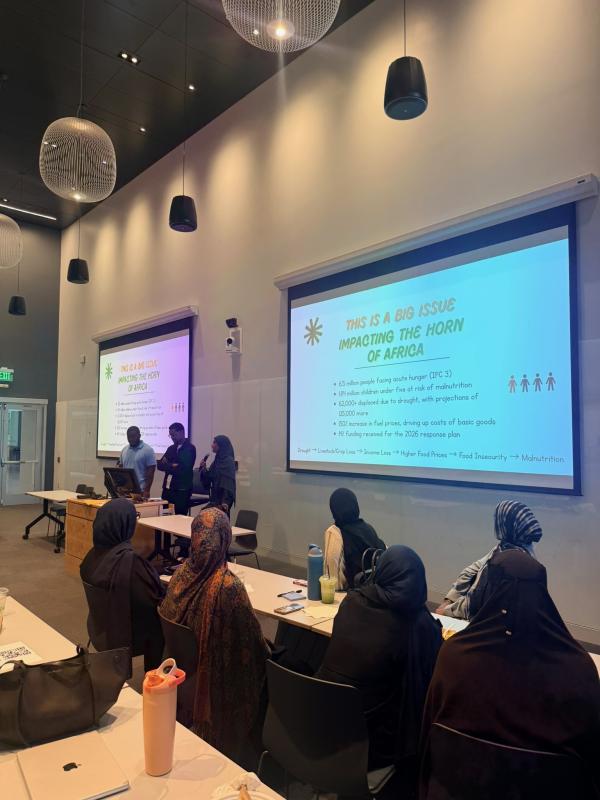
Here in Seattle, in partnership with CHanGE, Somali Health Board, SSP Seattle, and Cimilo iyo Caafimaad, S4S hosted its first Global Health and Sustainability: Building Resilience in the Diaspora conference, where they explored how health, food, and the environment connect and how community action can build a more sustainable and resilient future through interactive workshops and conversations with speakers and community leaders. It's an extension of what S4S has been building since 2023: climate solutions rooted in community, not separate from it.
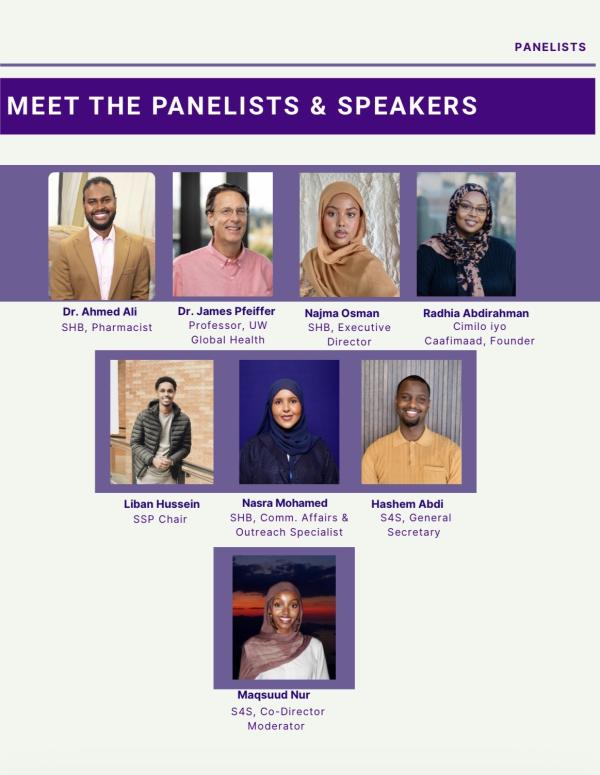
The August conference at UW, in the works since early 2026, was S4S's first event in the U.S., featuring panelists, speakers, and workshops that showcased how sustainability is woven into every facet of life. Speakers included Dr. James Pfeiffer, PhD, MPH; Dr. Ahmed Ali, PharmD; and Najma Osman, executive director of the Somali Health Board, who offered essential insights into public health issues at both the global and local levels.
"We chose global health and sustainability because sustainability weaves into every facet of our lives, specifically global health," Nur says. Many Somali communities in Washington have backgrounds in public health, with many members working in healthcare careers, and understanding this was a major motivator for the conference's global health focus. S4S hopes this event will be the first of many to bring Somali health professionals and community members together to discuss sustainability, and looks forward to continuing its work with UW Department of Global Health and CHanGE, both of which were instrumental in making this event possible.